Introduction
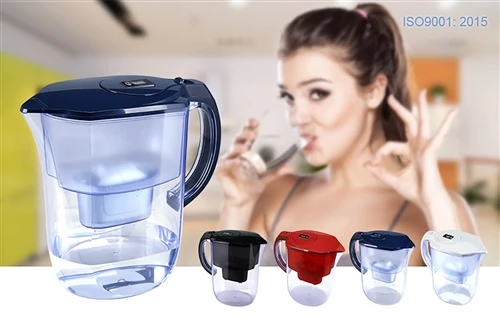
An alkaline water filter pitcher looks like a simple household object: a jug, a funnel, a cartridge, and a lid. Yet the difference between a good one and a poor one shows up in three places - what the water actually tastes like, what the cartridge removes, and how much the whole thing costs you per litre over a year. Buyers who compare on price alone often end up replacing cartridges every few weeks or drinking water that was never meaningfully filtered.
At Shenzhen Landun Environmental Technology, we manufacture alkaline water filter pitchers, jugs, and cartridges for distributors, retailers, and private-label brands worldwide. This guide covers the six factors that determine whether an alkaline water filter pitcher performs as advertised, plus the mistakes we see most often in product specification and retail buying.
Why Alkaline Water Filter Pitchers Sell
Three consumer trends keep this category growing. First, taste: removing chlorine and its by-products makes tap water noticeably more pleasant, which is the benefit most buyers notice immediately. Second, convenience: a pitcher needs no plumbing, no power, and no installation, so it works in apartments, offices, and rentals. Third, mineral interest: alkaline and mineral-enriched water has become a mainstream preference, and a pitcher is the lowest-cost way to try it.
That combination makes the alkaline water filter pitcher an easy product to sell - and an easy one to get wrong, because the category has little standardisation.
Factor 1: Filtration Media and What Is Removed
The cartridge is the product. Everything else is a container. A well-built alkaline water filter pitcher typically layers several media:
- Activated carbon block for chlorine, chloramine, taste, odour, and some organic compounds.
- Ion exchange resin to reduce hardness, heavy metals, and certain dissolved contaminants.
- Mineral media such as calcium, magnesium, or tourmaline balls to raise pH and add trace minerals.
- Fine mechanical filtration to trap sediment and keep carbon fines out of the drinking water.
Ask for the removal claims in writing, with test conditions. A cartridge that removes chlorine at 2 litres per minute may remove very little at the flow your pitcher actually sees.
Factor 2: pH Target and Mineral Content
Alkaline claims need scrutiny. A useful specification states both the input pH and the output pH, measured at a defined volume of water passed through the cartridge. Water entering at pH 7.2 and leaving at pH 8.5 is a meaningful change; a vague claim of "alkaline water" is not.
Mineral content matters for the same reason. Raising pH with magnesium and calcium also improves taste, which is why mineral-enriched cartridges generally score better in consumer tests than cartridges that rely on a single additive. Be sceptical of very high pH claims - extremely alkaline water tends to taste flat or soapy and may not be appropriate for everyone.
Factor 3: Cartridge Life and Cost per Litre
This is where retail value is really decided. Cartridge life is usually quoted in litres, and the honest way to compare products is cost per litre of filtered water. A cheaper alkaline water filter pitcher with a 100-litre cartridge can cost more over a year than a more expensive jug with a 250-litre cartridge.
Check how life is defined, too. Some suppliers quote total litres passed through; others quote litres of drinking water produced. And because alkaline media depletes before the carbon block does, the effective life of the whole cartridge is set by whichever layer fails first.
Factor 4: Certification and Material Safety
Drinking water products attract regulatory attention. Relevant evidence typically includes material safety compliance for every wetted part (for example, food-contact grade plastics), performance testing against recognised drinking-water standards, and declarations that the housing is BPA-free.
If you are selling into markets with strict requirements, request the test reports rather than relying on a datasheet. Certification gaps are the most common reason a shipment of an otherwise excellent alkaline water filter pitcher gets held at customs or rejected by a retailer's compliance team.
Factor 5: Capacity, Flow, and Everyday Usability
A pitcher must fit the way people actually live. Check the total capacity and, more importantly, the capacity of the upper reservoir - a 3.8-litre jug with a 1.2-litre upper tank requires three refills to fill the jug once, which is a common source of consumer complaints.
Flow rate determines patience. Gravity pitchers generally deliver filtered water in a few minutes; designs optimised for speed may pass water too quickly for full contact with the media. Also consider whether the pitcher fits in a refrigerator door, whether the lid seals for pouring, and whether the cartridge can be changed without tools.
Factor 6: Replacement Supply and Long-Term Support
Consumables are the long-term business. A retailer's real revenue from an alkaline water filter pitcher comes from repeat cartridge sales, so compatibility and availability matter as much as the initial product.
Confirm that the replacement cartridge is a stocked item with a stable part number, that the supplier will not change the fitting on a new revision without notice, and that retail packaging for cartridges is available separately. Brands that control their cartridge supply chain keep customers for years; brands that do not lose them after the first refill.
Working With Different Water Sources
Performance claims assume a particular input water quality, and real customers rarely have it. The same cartridge behaves differently across three common situations.
Municipal water with moderate hardness is the design case. Chlorine and its by-products are the main targets, mineral media restore taste, and cartridge life matches the published figure. This is where a standard pitcher performs best.
Very hard water consumes ion exchange capacity quickly. You will see scale on the kettle before the cartridge life indicator reaches zero, and the pitcher may need a shorter replacement interval than advertised. For these customers, pairing a jug with a descaling routine, or specifying a cartridge with higher resin loading, is the honest recommendation.
Soft or low-mineral water is the opposite problem: there is little for the media to correct, so mineral-enriched cartridges add the most noticeable improvement. Here the benefit is taste and mineral content rather than contaminant removal.
For retail buyers, the practical conclusion is to sell two cartridge variants rather than one, and to publish a simple water-hardness guide so customers can choose correctly. Returns in this category are almost always a mismatch between cartridge and water source, not a defective product.
Common Mistakes Buyers Make
- Judging by pitcher price alone. Cartridge cost per litre is the true measure of value.
- Trusting an unqualified pH claim. Without input pH, volume, and test method, the number is meaningless.
- Ignoring upper-reservoir capacity. Small reservoirs annoy users daily and drive returns.
- Skipping certification checks. Material and performance documentation is mandatory for many markets.
- Overlooking cartridge supply. A pitcher with no reliable replacement supply becomes waste within months.
FAQ
Q1: How does an alkaline water filter pitcher work?
Tap water passes by gravity through a cartridge containing activated carbon, ion exchange resin, and mineral media, which reduces chlorine and contaminants while raising pH and adding trace minerals.
Q2: How long does an alkaline water filter pitcher cartridge last?
Most cartridges are rated for 100 to 250 litres of water, roughly one to three months of typical household use. Replace on the rated volume, not on taste alone.
Q3: Is alkaline water safe to drink?
Water filtered and mineral-adjusted to a moderate pH, typically around 8 to 9, is widely consumed. Extremely high pH water is not recommended as a primary drinking source, and anyone with a medical condition should consult a professional.
Q4: Does an alkaline filter remove fluoride or heavy metals?
It depends on the media. Activated carbon alone does not remove fluoride; ion exchange and specialised media can reduce heavy metals and some other dissolved contaminants. Check the specific removal claims.
Q5: What is the difference between an alkaline pitcher and an RO system?
An alkaline pitcher filters by gravity, keeps minerals, and needs no installation. A reverse osmosis system forces water through a membrane, removes almost everything including minerals, and requires plumbing and power.
Q6: Can I use the pitcher with well water?
Only if the cartridge is specified for it. Well water varies widely and may need pre-treatment or a different cartridge formulation before an alkaline water filter pitcher will perform reliably.
Q7: How should cartridges be stored?
Keep sealed cartridges in a cool, dry place away from sunlight. Once installed, do not let the pitcher sit dry for long periods, and rinse a new cartridge before first use.
Conclusion
Specifying an alkaline water filter pitcher comes down to the cartridge: what it removes, what pH it achieves at what volume, how long it lasts, and whether replacements will still be available in two years. The jug itself only has to be well made, correctly sized, and easy to live with.
Shenzhen Landun Environmental Technology Co., Ltd. manufactures alkaline water filter pitchers, jugs and bottles, cartridges and carbon blocks, coffee machine water filters, and reverse osmosis purifiers for OEM and private-label customers worldwide. Send us your target market, capacity, and certification requirements, and our team will match a product and support your launch.