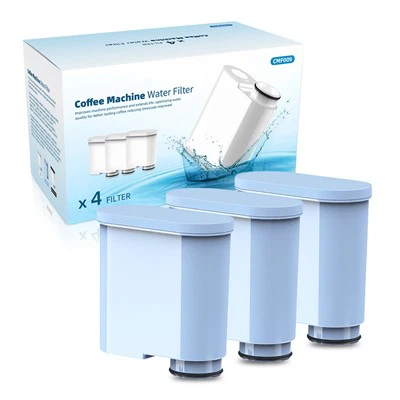
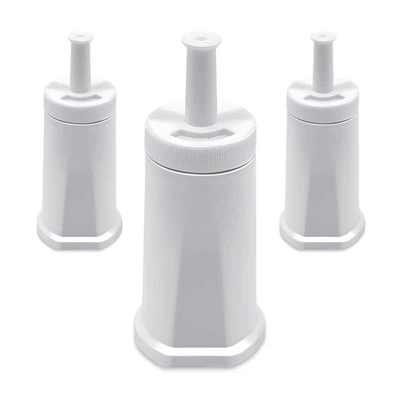
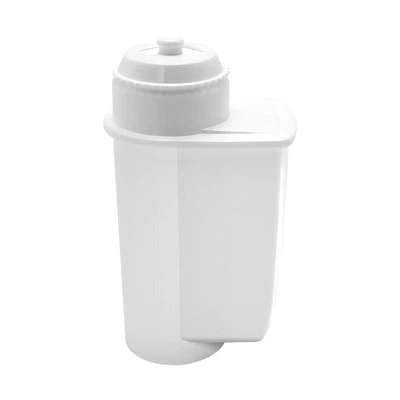
A coffee machine water filter looks like a commodity part, but it decides two things a customer notices immediately: how the espresso tastes, and how often the machine needs descaling. Get the fit or the ion exchange capacity wrong and you either leak water past the seal or leave scale forming inside a boiler that costs more to repair than the filter costs to buy. This guide explains what the cartridge actually does, how compatibility works across the major brands, and the six specifications to confirm before you place a container order.
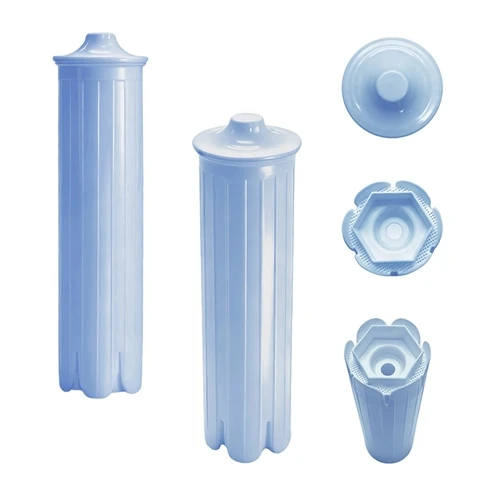
Why the Filter Matters More Than the Machine's Price Tag
Espresso machines heat water to 90–96 °C in a small boiler or thermoblock. Any calcium carbonate in that water precipitates out as scale, and scale insulates the heating element, reduces flow and eventually blocks the group. A coffee machine water filter removes most of that hardness before the water ever reaches the boiler, which is why manufacturers specify one even in soft-water regions.
For a distributor the argument is commercial. Filters are a repeat purchase with predictable replacement intervals, and a coffee machine water filter that fits properly keeps the end customer on the same part number for years. Compatibility failures, by contrast, generate returns and support tickets that wipe out the margin on the whole order.
What Is Inside a Coffee Machine Water Filter
Almost every cartridge on the market combines two stages. Ion exchange resin swaps calcium and magnesium ions for hydrogen or sodium ions, which is what actually reduces hardness. Granular or block activated carbon then adsorbs chlorine, chloramine and the organic compounds responsible for off-flavours, so the espresso tastes of coffee rather than of tap water.
Some designs add a fine mechanical pre-filter to catch rust and sediment from old pipework. The proportion of resin to carbon is what separates a serious cartridge from a cosmetic one: a cartridge that is mostly carbon will improve taste but leave hardness nearly untouched, and the boiler still scales.
Compatibility by Brand: The Fit Chart
Compatibility is decided by three things - the cartridge's physical profile, the sealing geometry and whether the machine reads a chip or a reset signal. The table below lists the common reference numbers that customers ask for.
| Machine brand | Common references customers quote | What decides compatibility |
|---|---|---|
| Jura | Claris Smart, Claris Blue, CMF-series | Some models read an RFID chip; without it the reminder never resets |
| Saeco / Philips | CA6702, CA6903 (AquaClean) | Reset through the machine menu; generation of the brewing unit matters |
| Breville / Sage | BES008, ClaroSwiss-compatible | In-tank and in-reservoir profiles are not interchangeable |
| Siemens / Bosch | TZ70003, 17000705 | EQ series uses a bayonet-style seat and a hardness setting in the menu |
| De'Longhi | DLSC002, SER3017 | Primadonna and Magnifica families use different seats |
Treat the table as a starting point. Always confirm the seat profile and the reset method against the machine's own manual, because manufacturers revise internals inside the same model name.
Criterion 1: Physical Fit and Sealing
The first test of any cartridge is whether it seats and seals. A cartridge that is 1 mm short in the neck will still look installed, and it will still let unfiltered water bypass the resin through the gap. Ask for the seat dimension, the O-ring hardness and the material of the housing before ordering.
- Seat geometry: bayonet, threaded, push-fit or in-tank float variants.
- O-ring material: EPDM or silicone, rated for potable water and for repeated thermal cycling.
- Housing: food-grade polypropylene or ABS without plasticisers that can leach at temperature.
- Tolerance: a supplier should be able to state the dimensional tolerance on the neck, not just the nominal size.
Criterion 2: Ion Exchange Capacity and Hardness Setting
Hardness capacity is normally quoted in litres at a stated German hardness, for example 60 litres at 10 °dH. That number is only meaningful with the hardness attached, because capacity falls as incoming hardness rises. If a datasheet quotes litres with no hardness figure, treat the value as marketing.
The machine's own hardness setting matters too. Most automatic machines let the user enter water hardness, and the reminder interval is calculated from that entry. A cartridge with a higher exchange capacity lets the customer set a longer interval, which reduces cost per litre but demands that the cartridge genuinely holds that much resin.
| Incoming hardness | Typical service life of a mid-range cartridge |
|---|---|
| Soft (under 7 °dH) | 90–120 litres |
| Medium (7–14 °dH) | 60–90 litres |
| Hard (14–21 °dH) | 35–60 litres |
| Very hard (over 21 °dH) | 20–35 litres, or pre-treat the supply |
Criterion 3: Carbon Quality and Taste Neutrality
Chlorine removal is the taste specification. Coconut-shell carbon with a high iodine number adsorbs faster and holds more than cheap coal-based carbon, and a block structure prevents channelling that lets water shortcut through the media. Ask what the carbon source is and whether the cartridge is flushed before first use.
A simple check in the field: brew a cup with filtered water and one with unfiltered water at the same temperature and dose. A coffee machine water filter in good condition removes the flat, papery notes of chlorinated water; a spent or low-grade cartridge leaves them in place even though the machine still runs.
Criterion 4: Bypass, Reminder and Electronics
Modern machines do not simply measure flow. Many use a chip, an RFID tag or a menu counter to decide when to prompt for replacement. This is where a cheap cartridge fails in a way the customer cannot fix: the cartridge fits and filters, but the reminder never resets, so the machine keeps demanding a new filter.
- Chip or RFID: confirm the chip generation and whether it can be reset by the user.
- Menu counter: a manual counter can be reset by any compatible cartridge.
- Bypass setting: the machine's hardness entry must match the cartridge's intended treatment level.
- Flow resistance: an over-dense cartridge can trip a low-flow fault on pump-controlled machines.
Criterion 5: Certification and Material Safety
Because the filter contacts drinking water at elevated temperature, certification is not a formality. Look for NSF/ANSI 42 for aesthetic claims and NSF/ANSI 53 where health-related reduction is claimed, and for a WQA or equivalent listing on the production line. Food-contact declarations for every wetted material should be available on request.
This is also the area where a compatible cartridge can match a genuine part. Compatibility is a statement about fit and function; certification is a statement about safety. A supplier should be able to provide both, in writing, before a private-label order ships.
Criterion 6: Cost per Litre and Supply Reliability
The honest comparison metric is cost per litre of treated water, not cost per cartridge. Divide the cartridge price by its rated litres at the customer's actual hardness, then add the cost of the descaling cycles avoided. A cartridge that costs twice as much but lasts three times longer and removes more hardness is usually the cheaper option over a year.
Supply reliability decides whether that maths holds. Replacement intervals are predictable, so a distributor needs a supplier who can hold stock, keep the same O-ring and media specification across batches, and provide private-label printing without changing the cartridge underneath.
Specification Checklist
Before you order a coffee machine water filter, confirm each of these in writing:
- Seat profile and neck dimensions, with tolerance.
- Capacity in litres at a stated hardness, plus fall-off data.
- Resin type and carbon source, with iodine number if available.
- Chip or RFID generation, or confirmation that a menu reset is used.
- NSF/ANSI 42 or 53 listing and food-contact declarations.
- Maximum operating temperature and pressure.
- Batch-to-batch consistency statement for O-rings and media.
- Private-label and packaging options, plus lead time.
Common Mistakes Buyers Make
- Matching by brand name only. Two machines with the same badge can use different seats.
- Buying on price per cartridge. Cost per litre at real hardness is the number that matters.
- Ignoring the chip generation. A coffee machine water filter that fits but cannot reset the reminder will be returned.
- Overlooking hardness settings. Leaving the machine set to soft water on a hard supply halves real cartridge life.
- Skipping certification documents. Water contact at temperature demands paperwork, not assurances.
- Forgetting descaling correlation. Even with a filter, most manufacturers still require periodic descaling.
FAQ
Q1: Is a compatible coffee machine water filter as good as the original?
It can be, if the resin quantity, carbon quality, seat geometry and chip behaviour match. Ask for the capacity at a stated hardness and the certification listing, then compare those numbers with the original rather than comparing packaging.
Q2: How often should a coffee machine water filter be replaced?
Follow the litres-at-hardness figure first and the machine's reminder second, whichever comes sooner. In practice most households replace every two to three months, and busy offices far more often.
Q3: Can I use a coffee machine water filter with hard tap water?
Yes, but expect a shorter interval and set the machine's hardness entry honestly. Above roughly 21 °dH, many suppliers recommend blending with a softened or RO supply rather than relying on the cartridge alone.
Q4: Why does my machine still ask for a new filter after replacement?
Almost always a missing or incorrect chip, or a counter that was not reset in the menu. Confirm the chip generation for your model before ordering a coffee machine water filter.
Q5: Does filtered water change the taste of espresso?
Yes. Removing chlorine and reducing carbonate hardness makes the extraction more consistent and lets the coffee's own acidity and sweetness come through rather than a flat, papery note.
Q6: Do I still need to descale if I always use a filter?
Most manufacturers still require periodic descaling, because a filter reduces but does not eliminate scale. Skipping descaling entirely voids many warranties.
Q7: Can I order private-label coffee machine water filters?
Yes, and this is common for distributors. Specify the seat profile, capacity, chip option, certification documents and packaging artwork, then request pre-production samples for fit testing on real machines.
Choosing a Coffee Machine Water Filter You Can Stand Behind
The specification is simple once the questions are in order: confirm the seat, the capacity at real hardness, the chip behaviour and the certification, and the rest is supply and margin. Do that and the filter becomes a repeatable, high-retention line rather than a source of returns.
Shenzhen Landun Environmental Technology manufactures alkaline filter pitchers, RO systems and coffee machine water filter cartridges for machine brands including Jura, Saeco, Philips, Breville, Sage, Siemens and De'Longhi. Send us the machine model or the reference number on the old cartridge, and our engineers will confirm the seat profile, capacity at your incoming hardness and the chip option before you commit to a production run.